
PEMF vs Laser Therapy for Horses: Which Is Right?
Comparing two popular equine therapies — PEMF and cold laser. Learn how they work differently, when each is most effective, and whether they can be used together.
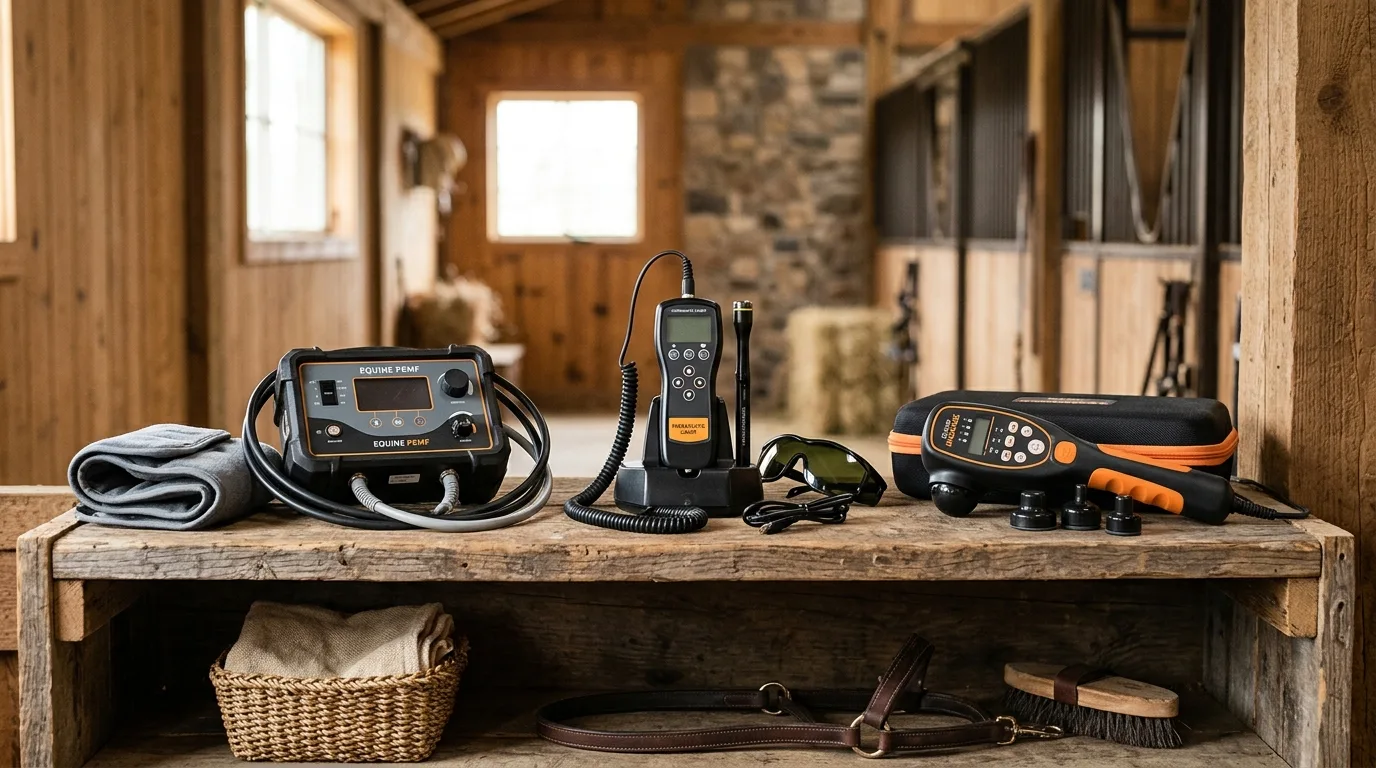
PEMF vs Laser Therapy for Horses: Which Is Right?
Horse owners looking for non-invasive therapy options often find themselves choosing between two popular treatments: PEMF (Pulsed Electromagnetic Field) therapy and cold laser (also called low-level laser therapy, or LLLT). Both are legitimate therapeutic modalities with real clinical evidence behind them. But they work differently, and each has situations where it shines.
Here’s a practical comparison to help you decide which makes sense for your horse — or whether using both might be the best approach.
How PEMF works
PEMF therapy delivers pulsed magnetic fields into the body using a coil or loop applicator. These pulses penetrate through skin, muscle, and bone to reach cells deep in the tissue. The magnetic energy restores the electrical charge of damaged cells, which triggers a cascade of healing responses: increased blood flow, reduced inflammation, improved nutrient delivery, and faster waste removal.
The key advantage of PEMF is its depth of penetration. Professional-grade systems like the Magna Wave can reach structures deep in the body — joints, bones, tendons, and organs — that are difficult to access with surface-level therapies.
PEMF also treats a large area in each session. A single coil pass covers the entire shoulder, the full length of the back, or an entire limb. This makes it efficient for whole-body treatments and for conditions that affect multiple areas.
How cold laser therapy works
Cold laser therapy uses concentrated light at specific wavelengths (typically 600-1000nm) to stimulate cellular activity. The photons are absorbed by mitochondria in the cells, which increases ATP production and activates cellular repair pathways.
Laser therapy is precise. The beam can be focused on a small, specific area — a particular tendon, a surgical incision, or a localized wound. This precision is its main advantage: you’re delivering therapeutic energy exactly where it’s needed.
However, laser light has limited penetration compared to magnetic fields. Most cold laser devices effectively treat tissue within 2-5 centimetres of the skin surface. Deeper structures — the centre of a large joint, the deep digital flexor tendon, or the internal structures of the hoof — are harder to reach with light alone.
When PEMF is the better choice
PEMF tends to be more effective for:
- Deep joint conditions like hock arthritis or coffin joint inflammation, where the target tissue is surrounded by bone and dense connective tissue
- Whole-body soreness after competition or heavy training, where the goal is reducing inflammation and muscle fatigue across the entire body
- Chronic conditions like generalized arthritis, where multiple areas need treatment simultaneously
- Laminitis support, where improved blood flow to the laminae deep within the hoof capsule is the primary goal
- Back pain and spinal conditions, where the target muscles and joints are under layers of tissue
When laser therapy is the better choice
Cold laser tends to be more effective for:
- Superficial wounds and surgical incisions, where precise, targeted healing is needed at the skin surface
- Localized tendon inflammation in the early acute stage, especially when the tendon is close to the surface (like the SDFT)
- Small focal injuries where you need concentrated energy in a very specific spot
- Skin conditions like rain rot, scratches, or proud flesh, where surface-level treatment is the goal
Can they be used together?
Yes, and in many cases this is the best approach. PEMF and cold laser work through different biological mechanisms and target different tissue depths. Using both gives you broad, deep-reaching inflammation reduction from PEMF and precise, targeted surface healing from laser.
A common protocol for a horse recovering from a suspensory injury, for example, might include weekly PEMF sessions for systemic inflammation reduction and improved circulation, with laser therapy applied directly over the lesion site between PEMF appointments.
Practical considerations
Cost: PEMF sessions typically run $85-$120 per visit. Laser therapy sessions are usually $50-$80 per visit, but may require more frequent treatments. Neither is typically covered by equine insurance, though some policies are starting to include complementary therapies.
Availability: PEMF practitioners are less common than laser therapists in many areas. In the Peterborough and Kawartha Lakes region, we bring Magna Wave PEMF directly to your barn, making access straightforward.
Session time: PEMF full-body sessions run 45-60 minutes. Laser sessions are typically shorter — 15-30 minutes for a targeted area.
The bottom line
Neither therapy is universally “better.” PEMF excels at deep, systemic treatment across large areas. Laser excels at precise, superficial treatment of specific sites. For many horses, the ideal approach uses both — PEMF for the big picture and laser for targeted follow-up.
If you’re unsure which therapy your horse needs, reach out to us. We’re happy to discuss your horse’s condition and recommend the right approach — even if that means referring you to a laser practitioner for part of the treatment plan.